
The Five Pillars Of Kindergarten Readiness
Annika Chadhais the creator of the Countdown2K kindergarten readiness app and winner of the 2023 Congressional App Challenge for Kentucky's Third District.
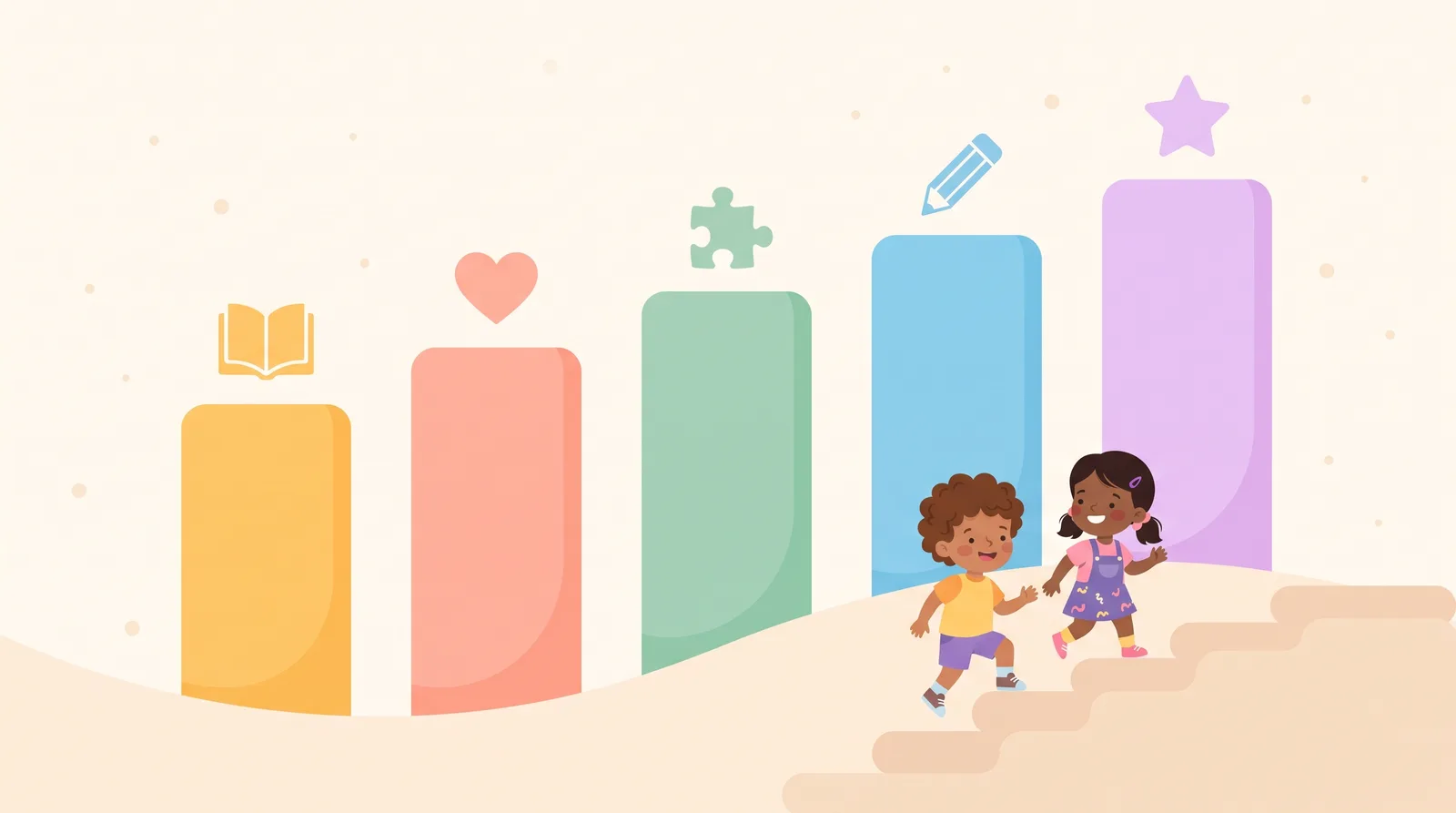
Parents often worry if their child is ready for kindergarten. Kindergarten readiness includes knowing the alphabet, numbers, and shapes. This post breaks down the five pillars to help children succeed.
Discover how to prepare your child today.
Key Takeaways
Early Education Builds Skills
Pre-K programs help children learn letters, numbers, and shapes. They also improve language and social skills.
Quality and Diverse Teachers Matter
Good teachers use effective methods to teach reading and thinking. Diverse leaders provide role models for all kids.
Cognitive Skills and Problem-Solving
Developing curiosity, critical thinking, and problem-solving abilities helps children navigate classroom learning and build academic confidence.
Strong Literacy Skills
Children learn to read and write through phonemic awareness, letter recognition, and storytelling activities that build a love of learning.
Physical Growth and Self-Control
Developing motor skills and self-control helps children succeed in kindergarten and beyond.
Pillar 1: Why Does Early Childhood Education Matter?
The first pillar of kindergarten readiness is access to quality early childhood education. Research from the National Institute for Early Education Research (NIEER) consistently shows that children who attend high-quality pre-K programs score higher on kindergarten readiness assessments across all developmental domains — literacy, math, social-emotional skills, and physical development.
What makes early education effective isn't just attendance — it's the quality of instruction. Programs that combine structured learning with guided play, maintain small class sizes, and employ teachers with specialized early childhood training produce the strongest outcomes. In Jefferson County Public Schools, where nearly 100,000 students are served, expanding access to quality pre-K has been a key strategy for closing readiness gaps.
Expansion of pre-K programs and support for early childhood educators
Quality pre-K programs boost language skills, early literacy, and social-emotional development simultaneously. The American Academy of Pediatrics finds that early literacy promotion — like reading aloud starting in infancy — gives children a lasting boost in language development. Educators trained in developmentally appropriate practices use systematic instruction and differentiated techniques to meet each child where they are — ensuring that both advanced learners and those who need extra support make progress.
"Investing in pre-K ensures every child starts school ready to learn."
Pillar 2: Why Do High-Quality and Diverse Teachers Matter?
The quality of a child's teacher is the single most important in-school factor affecting their learning outcomes. Research published by the Economic Policy Instituteshows the difference between an effective and an ineffective teacher can exceed a full year of achievement growth. In early childhood education, this impact is even more pronounced because young children's brains are in their most rapid period of development.
Diversity in educational leadership matters too. When children see teachers and leaders who look like them and share their backgrounds, they develop stronger self-identity and academic motivation. Research by Gershenson and colleagues found that Black students who have at least one Black teacher in early elementary school are significantly more likely to graduate high school.
Initiatives to elevate teaching standards and diversify educational leadership
Programs are expanding to support early childhood educators. Training focuses on phonics, vocabulary development, and literacy skills. Schools offer workshops to enhance teaching methods.
Diversity in leadership is growing with more women and minority leaders. Scholarships help new teachers enter the field. Mentorship programs guide educators in their careers. These initiatives ensure all children receive high-quality instruction and diverse role models.
Pillar 3: How Do Cognitive Skills and Problem-Solving Develop?
Cognitive development is the foundation of academic learning. Children who develop strong thinking skills, curiosity, and problem-solving abilities are better equipped to navigate the classroom environment and tackle new challenges with confidence.
Building critical thinking through play and exploration
Research from the National Association for the Education of Young Children (NAEYC) shows that children learn best through hands-on exploration and play-based activities. Sorting objects by color and shape, building with blocks, and completing simple puzzles all strengthen cognitive skills like pattern recognition, classification, and spatial reasoning. These activities help children develop the mental flexibility needed for math concepts and reading comprehension.
Parents can support cognitive development at home through everyday activities. Counting items at the grocery store, asking open-ended questions during storytime, and encouraging children to predict what happens next all build critical thinking skills. The Countdown2K app includes interactive games specifically designed to strengthen these cognitive foundations through age-appropriate challenges that grow with your child.
Pillar 4: How Do Strong Literacy Skills Take Root?
Early literacy is the foundation for everything a child will learn in school. Long before children read independently, they build phonemic awareness (hearing the individual sounds in words), letter recognition, print awareness, and the vocabulary they need to understand what they will one day read. The American Academy of Pediatrics recommends shared reading beginning in infancy because of its lasting boost to language development.
The scale of the opportunity is striking. An Ohio State studyestimated that children whose parents read them five books a day enter kindergarten having heard about 1.4 million more words than children who are never read to — and even one book a day adds up to nearly 300,000 words by age 5. That exposure builds the vocabulary and comprehension children draw on when formal reading instruction begins.
Everyday ways to build literacy
Read together daily and talk about the story — ask what might happen next, or how a character feels. Point out letters and words on signs, menus, and packages. Sing songs and play rhyming games to sharpen phonemic awareness. Encourage scribbling and pretend writing, which teach children that marks on a page carry meaning. And invite storytelling: a child narrating their day or retelling a favorite book is building the narrative skills that support later reading comprehension.
Pillar 5: Why Do Physical Growth and Self-Control Matter?
Kindergarten asks a lot of small bodies: holding a pencil, using scissors, managing zippers and lunch containers, sitting for circle time, and moving safely through a busy classroom. Fine motor skills prepare hands for writing and drawing, while gross motor skills — running, jumping, balancing, climbing — build the strength, coordination, and stamina children need to get through a full school day.
Just as important is self-control: managing emotions, waiting for a turn, following multi-step directions, and sticking with a task. Johns Hopkins research on Baltimore kindergartnersfound that children who entered school without social-behavioral readiness were 80% more likely to be held back a grade and roughly three times more likely to be suspended or expelled by fourth grade — a reminder that self-regulation matters as much as letters and numbers.
Everyday ways to build these skills
Make outdoor play a daily habit — playgrounds, bikes, and ball games all build gross motor strength. Arts and crafts like cutting, gluing, and drawing develop the hand strength and dexterity needed for writing. Games like "Simon Says," freeze dance, and taking turns in board games give children fun, low-stakes practice at impulse control. And predictable daily routines let children rehearse the transitions they'll navigate dozens of times a day in kindergarten.
Conclusion
Preparing your child for kindergarten sets them up for success — not just in the first year of school, but throughout their entire educational journey. Research shows that children who enter kindergarten with strong foundations in all five pillars — early education, quality teachers, cognitive development, literacy skills, and physical growth — maintain that advantage through elementary school and beyond.
The good news is that every pillar can be strengthened through intentional, everyday activities. Reading together builds literacy. Puzzles and sorting games develop cognitive skills. Outdoor play strengthens motor development. And social interactions — from playground visits to family dinners — build the emotional intelligence children need to thrive in a classroom setting.
Start today with the Countdown2K app, which covers all five developmental pillars through 13 research-aligned games. For a comprehensive assessment of where your child stands, download our Kindergarten Readiness Checklist. And to understand the lasting impact of early preparation, read our article on the long-term impact of kindergarten readiness.
FAQs
1. What are the five pillars of kindergarten readiness?
The five pillars are early childhood education, high-quality and diverse teachers, cognitive development and problem-solving, strong literacy skills, and physical growth and self-control. Together they help preschoolers prepare to read, write, and interact in school.
2. How does phonological awareness support reading skills?
Phonological awareness helps children recognize phonemes and graphemes. This skill is crucial for learning to read and write, as it builds the foundation for the alphabetic principle and sight words.
3. Why are fine and gross motor skills important for kindergarten readiness?
Fine motor skills, like dexterity, help with writing. Gross motor skills support activities like running and jumping. Both are essential for overall physical development and classroom participation.
4. How does language development influence kindergarten readiness?
Language development improves communication skills and receptive language. It helps children express their thoughts, understand instructions, and engage in storytelling and reading aloud.
5. What role does creativity play in preparing for kindergarten?
Creativity allows children to think critically and solve problems. It enhances their ability to generate ideas, engage in storytelling, and participate in activities that promote intellectual development.
6. How can differentiated instruction benefit preschoolers' readiness for kindergarten?
Differentiated instruction meets each child's unique needs. It supports English learners and those in special education, ensuring all children develop the necessary skills in reading, writing, and other disciplines for kindergarten success.